Signed in as:
filler@godaddy.com
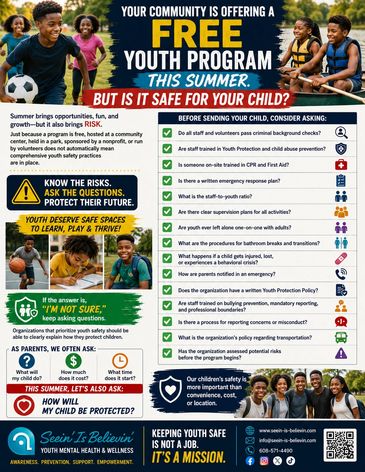
🚨 YOUR COMMUNITY IS OFFERING A FREE YOUTH PROGRAM THIS SUMMER.
BUT IS IT SAFE FOR YOUR CHILD?
Summer is here, and communities are launching camps, sports clinics, enrichment programs, neighborhood events, church activities, and one-day youth experiences.
Many of these programs are doing amazing work for young people.
But before you
🚨 YOUR COMMUNITY IS OFFERING A FREE YOUTH PROGRAM THIS SUMMER.
BUT IS IT SAFE FOR YOUR CHILD?
Summer is here, and communities are launching camps, sports clinics, enrichment programs, neighborhood events, church activities, and one-day youth experiences.
Many of these programs are doing amazing work for young people.
But before you register your child, ask yourself:
❓ Have you asked what safety measures are in place?
Just because a program is free, hosted at a community center, held in a park, sponsored by a nonprofit, or run by volunteers does not automatically mean comprehensive youth safety practices are in place.
Many organizations have great intentions. However, if youth programming is not their primary area of expertise, they may not realize everything needed to keep children safe.
Before sending your child, consider asking these questions:
✅ Do all staff and volunteers pass criminal background checks?
✅ Are staff trained in Youth Protection and child abuse prevention?
✅ Is someone on-site trained in CPR and First Aid?
✅ Is there a written emergency response plan?
✅ What is the staff-to-youth ratio?
✅ Are there clear supervision plans for all activities?
✅ Are youth ever left alone one-on-one with adults?
✅ What are the procedures for bathroom breaks and transitions?
✅ What happens if a child gets injured, lost, or experiences a behavioral crisis?
✅ How are parents notified in an emergency?
✅ Does the organization have a written Youth Protection Policy?
✅ Are staff trained on bullying prevention, mandatory reporting, and professional boundaries?
✅ Is there a process for reporting concerns or misconduct?
✅ What is the organization's policy regarding transportation?
✅ Has the organization assessed potential risks before the program begins?
If the answer is, "I'm not sure," keep asking questions.
Organizations that prioritize youth safety should be able to clearly explain how they protect children.
As parents, we often ask:
✔️ What will my child do?
✔️ How much does it cost?
✔️ What time does it start?
This summer, let's also ask:
✔️ How will my child be protected?
Our children's safety is more important than convenience, cost, or location.
Because keeping youth safe is not a job.
It's a mission.
#SummerSafety #YouthProtection #ChildSafety #Parenting #SummerPrograms #SafeCommunities #YouthDevelopment #SeeinIsBelievin #ProtectOurYouth #KeepingYouthSafe #YouthSafety #CommunitySafety :::
As our children head into summer break, it's important to remember that summer brings more than sunshine and fun—it also brings increased risks that can have life-changing consequences.
Did you know?
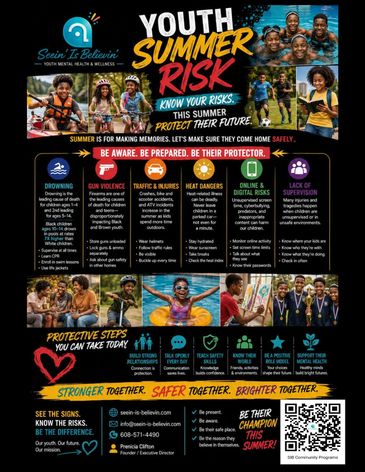
⚠️ Drowning is one of the leading causes of death for children, and Black children ages 10-14 drown at rates more than 7 times higher than
As our children head into summer break, it's important to remember that summer brings more than sunshine and fun—it also brings increased risks that can have life-changing consequences.
Did you know?
⚠️ Drowning is one of the leading causes of death for children, and Black children ages 10-14 drown at rates more than 7 times higher than their White peers.
⚠️ Gun violence remains one of the leading causes of death for children and teens, disproportionately impacting Black and Brown youth.
⚠️ Motor vehicle crashes, bicycle and scooter accidents, and pedestrian injuries increase during the summer months as children spend more time outdoors.
⚠️ Heat-related illnesses can quickly become deadly, especially during extreme temperatures.
⚠️ Unsupervised time, online activity, peer pressure, and risky decision-making can place youth in dangerous situations when school is out.
The good news? Many of these tragedies are preventable.
✅ Enroll children in swim lessons and actively supervise them around water.
✅ Store firearms unloaded, locked, and separate from ammunition.
✅ Require helmets for bikes, scooters, and skateboards.
✅ Keep children hydrated and never leave them in a parked vehicle.
✅ Know where your children are, who they're with, and what they're doing.
✅ Maintain open conversations about safety, mental health, online activity, and making good choices.
One of the strongest protective factors for young people is having caring, engaged adults in their lives. This summer, let's do more than keep our children busy—let's keep them safe.
Every conversation matters.
Every check-in matters.
Every precaution matters.
Let's work together to ensure our children return to school healthy, happy, and ready to thrive.
#SummerSafety #ProtectOurYouth #BlackYouthMatter #BrownYouthMatter #YouthMentalHealth #SeeinIsBelievin #ProtectiveFactors #SafeSummer
Hey, just another friendly PSA during April Child Abuse Prevention Month…
☀️ Summer is right around the corner, and with that comes a surge of programs—mentorship programs, camps, tutoring, and after-school opportunities for our young people.
And while these spaces can be incredibly valuable, this is also the time to slow down and reall
Hey, just another friendly PSA during April Child Abuse Prevention Month…
☀️ Summer is right around the corner, and with that comes a surge of programs—mentorship programs, camps, tutoring, and after-school opportunities for our young people.
And while these spaces can be incredibly valuable, this is also the time to slow down and really think about how these programs are structured—not just what they offer.
One area I always encourage families to take a closer look at is one-on-one mentoring and tutoring models.
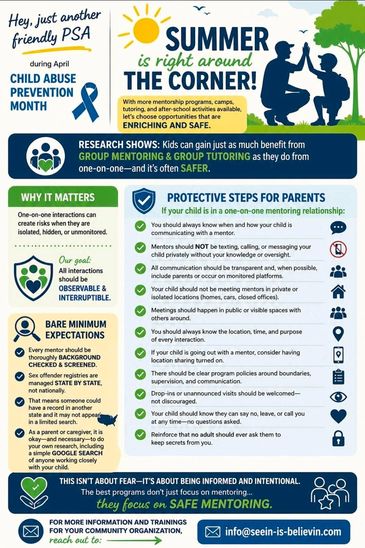
We’ve learned over time that this model, while well-intentioned, is not always the safest approach when it lacks structure and oversight. Research shows young people can gain just as much benefit from group mentoring and group tutoring—without the added risks that can come with isolated, one-on-one interactions.
From a youth protection standpoint, the goal is simple:
All interactions should be observable and interruptible.
If your child is participating in one-on-one mentoring, here are some protective steps you can take as a parent or caregiver:
• You should always know when and how your child is communicating with a mentor
• Mentors should not be texting, calling, or messaging your child privately without your knowledge or oversight
• All communication should be transparent and, when possible, include parents or occur on monitored platforms
• Your child should not be meeting mentors in private or isolated locations (homes, cars, closed offices)
• Meetings should happen in public or visible spaces with others around
• You should always know the location, time, and purpose of every interaction
• If your child is going out with a mentor, consider having location sharing turned on
• There should be clear program policies around boundaries, supervision, and communication
• Drop-ins or unannounced visits should be welcomed—not discouraged
• Your child should know they can say no, leave, or call you at any time—no questions asked
• Reinforce that no adult should ever ask them to keep secrets from you
And let’s be clear about the bare minimum expectations:
• Every mentor should be thoroughly background checked and screened
• Organizations should not rely on a single check—because sex offender registries are managed state by state, not nationally
• That means someone could have a record in another state and it may not appear in a limited search
• As a parent or caregiver, it is okay—and necessary—to do your own research, including a simple Google search of anyone working closely with your child
This isn’t about fear—it’s about being informed and intentional.
The best programs don’t just focus on mentoring… they focus on safe mentoring.
Before you sign up this summer, ask the questions, understand the structure, and make sure your child is in an environment where safety is built into every interaction.
---
For more information and trainings for your community organization, reach out to:
info@seein-is-believin.com